

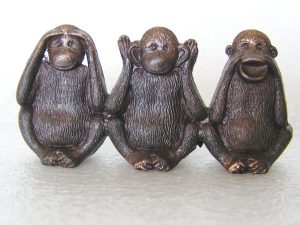
 You’ve probably seen the opposite of this three wise monkeys image numerous times. In fact, it’s been around for at least 400 years. Learning styles reflect a similar concept. But, contrary to popular belief, learning styles aren’t so much a way to identify how to put things in into your mind, but more of a filing system to help you retrieve things you’ve learned as quickly as possible. Your child will still need to have a well-rounded understanding of the subject matter, which means absorbing it through visual, auditory and kinesthetic modalities whenever possible…but he can use his preferred “shorthand” to file it in a way that he can pull it out as quickly and effortlessly as possible.
Why is this important? Most tests (including the standardized, high-stakes variety) are timed. So every edge you can give your child to help pull out the knowledge he has worked so hard to learn is important.
Think back on your last vacation. What do you remember first? What you saw? What you heard? What you felt or did? You took in memories through all your senses, but one sense resurfaced fastest. Similarly, your child will remember one aspect of a concept first/fastest.
If a child relates to the world by the way it LOOKS…and talks about memories in a context of IMAGERY (versus sounds or feelings), the student naturally prefers to recall information VISUALLY.
If Your Child Learns Best By Seeing…
- Find videos on YouTube, Khan Academy, TeacherTube, etc., of the concepts he is learning in class so that your child can “see” the lesson again.
- Teach your child to Mind Map, Venn Diagram or timeline concepts.
- Encourage your child to illustrate homework problems to be solved. For instance, if a word problem is “Mary has 3 apples and Suzy takes 2 of them. How many apples does Mary have left?”, then have your child draw two stick figures and three apples under one stick figure, then circle two of the apples and draw an arrow to Suzy.
- Talk to your child’s teacher about giving him scratch paper during quizzes and tests so that he can diagram or illustrate test questions as necessary.
To Learn More About Why We Feel Cognitive Style Preferences Are Important, Click Here →